Ordo Universi · Tribal Leader
47 ﹁
The 47 Society
Degrees 20–54
The Forty-Sixth Untying gave you the Carrying Flame. The Forty-Seventh gives you a joke worth keeping for sixty years.
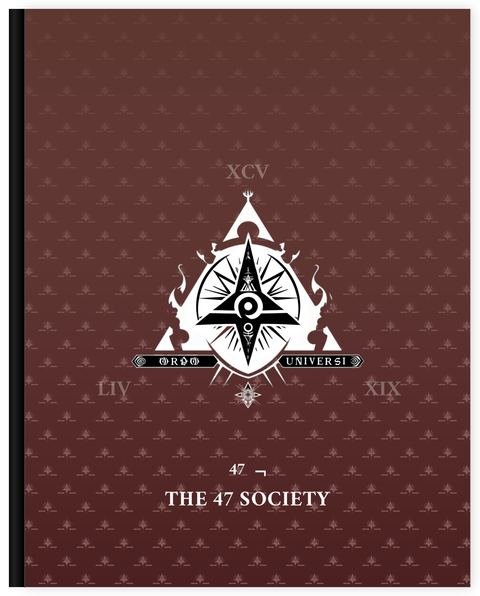
47 ﹁ The 47 Society is the forty-seventh of the ninety-five untyings of the Order of the Universe, and the twenty-eighth degree of Akteilaos, the Tribe. Its knot is the Broken Joke — a symbol a community has chosen together, deliberately, knowing full well it was chosen and not discovered, which breaks in either of two directions: taken literally once the knowing wink curdles into unexamined doctrine, or abandoned out of embarrassment once a community decides that a thing "only" a joke is beneath serious keeping. The untying is the Kept Joke: holding a chosen sign with both hands at once, fully aware it is arbitrary, fully invested in it anyway, because the shared, ongoing choice to keep it was always where its value lived.
This is a full monograph of sixty-four pages with twelve engraved plates, moving through the number forty-seven on every level the Order recognizes:
The Mythological — Pomona College's real Society of 47, founded after Professor Donald Bentley's 1964 tongue-in-cheek classroom "proof" that every number equals forty-seven, its scrapbooks of documented sightings still kept by the college's mathematics department; alumnus Joe Menosky carrying the number, beginning in Star Trek: The Next Generation's fourth season, into four decades of scripts across three series, adopted by fellow writers and still tracked today by a fandom that has never once mistaken the bit for a message. Set explicitly as a companion to — not a repetition of — Degree 23's Enigma of Twenty-Three, since nobody who ever kept this particular joke mistook it for literal truth.
The Spiritual — Émile Durkheim's The Elementary Forms of Religious Life (1912) and his real sociological account of totemism: that a community's cohesion never lives inside the totem itself, but in the shared, sustained act of reverence a group directs toward it, chosen and re-chosen together. The 47 Society and its televised afterlife stand as an unusually clean demonstration of Durkheim's own claim — proof that a symbol need never be true to do real binding work, so long as the choosing to keep it stays a choosing.
The Numerological — the Order's own reading of forty-seven: its digit-root returning, with real weight, to Degree 2's own teaching of Duality, the capacity to hold two true things at once without splitting to do it; and dama&umin, the Order's pre-existing word for cheerfulness, adopted rather than built, whose five consonants sum — found, not forced — to exactly forty-seven (igli] 47.15).
The Developmental — the Age of Forty-Seven: the quiet audit of a life's accumulated traditions — the family toast, the office ritual, the running joke — sorting themselves, often for the first time with any clarity, into what is still genuinely alive and what has gone hollow with unexamined repetition; and the harder, rarer skill of transmitting a kept tradition's history alongside its form to whoever encounters it new.
The Operative — stewardship of what a Tribe holds in common rather than command over its members: the discipline of noticing which shared traditions still generate real delight and which have calcified into obligation, and the courage neither to enforce a dead bit as sacred law nor to discard a living one out of embarrassment. A sustained practice for the Tribe-band initiate in discerning, and in teaching newcomers to hold, exactly this difference.