
Ordo Universi · World Leader
65 ﹁
Terbium and the Name Come True
Degrees 55–95
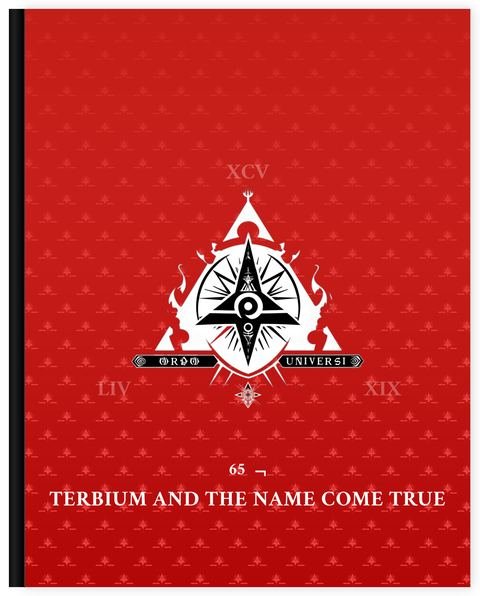
The Sixty-Fourth Untying called a founder's name forth over the thing his work made possible. The Sixty-Fifth asks what happens when a name was never quite right to begin with: can a name born of honest error become, through decades of real use, simply and permanently true?
65 ﹁ Terbium and the Name Come True is the sixty-fifth of the ninety-five untyings of the Order of the Universe, the eleventh degree of Mxk]iatar, the World, and fresh ground, unrelated to Degree 64's own material. Its knot is the Lost Name — an original naming, genuinely displaced by an honest historical mix-up, so that the "true" first intention was lost. The untying is the Name Come True: the same name, settled by more than a century of consistent, honest use into something simply, permanently real — not awaiting correction, but true in its own right.
This is a full monograph of sixty-two pages with twelve engraved plates, moving through the number sixty-five on every level the Order recognizes — teaching, as at Fifty-Five through Sixty-Four, no new letter or sign, since the whole script already stands complete, and teaching the optative mood — the grammar of wishing and blessing.
The Mythological — the real, thirty-four-year history of terbium, element sixty-five: Carl Gustaf Mosander's 1843 splitting of yttria into three named earths, one of which — his own "terbia" — was mistakenly renamed "erbium" by Nils Johan Berlin around 1860, and correctly re-identified only in 1877 by Marc Delafontaine, who nonetheless named it, at last, terbium — permanently swapped from Mosander's original intent, and never corrected back.
The Spiritual — the Buddhist Karaniya Metta Sutta, blessing "all beings... the seen and unseen, born and yet to be born" — a wish extended even toward what does not yet exist.
The Numerological — sixty-five's own digit-root, folding twice to two: the higher-octave witness to Degree 2, Duality, where genuine contradiction resolves not into correction but into paradox — held honestly alongside the fact that the native name's own arithmetic does not repeat this echo, stated plainly rather than forced.
The Developmental — the reckoning of an identity or role once begun in error, settled by decades of honest living into something simply, permanently true.
The Operative — the discipline of leadership that recognizes when a convention born of honest error has, through consistent lived use, become the real and legitimate standard.